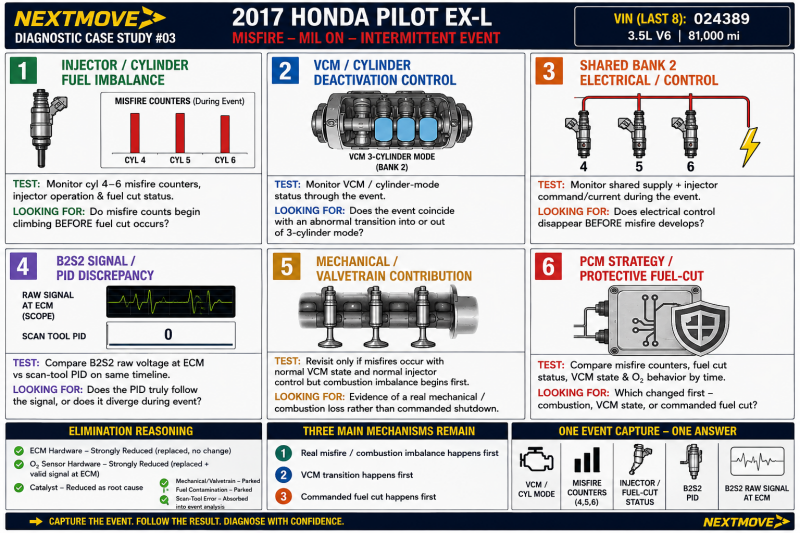
2017 Honda Pilot EX-L — 3.5L V6, 83,000 miles. Intermittent Bank 2 misfire, MIL on. DTCs: P0304, P0305, P0306, P0300, P219B.
The evidence: this vehicle had already had extensive work done, with no change to the fault — Bank 2 catalyst, Bank 1 catalyst, upstream and downstream O2 sensors, spark plugs, a valve adjustment, a Motorvac service, back-pressure testing, a new battery, and an ECM replacement and reprogram. The fault stayed intermittent. Most of the time, fuel trims were normal. Then, while idling, the event occurred: all three Bank 2 cylinders showed fuel cut, and at the same moment the scan tool displayed B2S2 = 0V. But when the technician back-probed the B2S2 signal at the ECM with an oscilloscope, the electrical signal was still present. That's the contradiction this case turns on: the scan tool says 0V, the signal at the ECM says otherwise, and three cylinders on the same bank are shutting down together.
Six directions considered:
A — injector/cylinder fuel imbalance: does a real combustion imbalance begin before the fuel cut occurs?
B — VCM / cylinder-deactivation control: does an abnormal deactivation event coincide with the fault?
C — shared Bank 2 electrical / injector control: does a common supply or control path disappear first?
D — B2S2 signal / PID discrepancy: does the scan-tool PID actually follow the electrical signal, or does it diverge during the event?
E — mechanical / valvetrain contribution: is there still a genuine combustion fault underneath the event?
F — PCM protective fuel-cut strategy: are the misfires causing the fuel cut, or is the fuel cut causing the misfire codes?
Narrowing it down: some directions could be reduced before testing even started. ECM hardware was strongly reduced — it had already been replaced and reprogrammed with no change. O2 sensor hardware was strongly reduced too, having been replaced and still showing a valid signal at the ECM. The catalysts were reduced as an initiating cause. The mechanical/valvetrain direction was parked, not eliminated, pending what the event sequence actually showed. That left three real mechanisms in play: a genuine misfire or combustion imbalance happening first, a VCM transition happening first, or a commanded fuel cut happening first.
The separator test: capture a single event while monitoring five things on the same timeline — VCM/cylinder mode, the misfire counters for cylinders 4, 5 and 6, injector/fuel-cut status, the B2S2 scan-tool PID, and the B2S2 raw signal at the ECM. Then ask one question: which event moves first? If the misfire counts rise first, the injector/cylinder direction gets investigated. If VCM changes first, VCM control gets investigated. If the fuel cut occurs first while VCM stays normal, the shared control trigger gets investigated. If the B2S2 PID drops but the raw signal stays present, the O2 sensor circuit stops being chased. The point of the test isn't to add more possibilities — it's to eliminate them.
Outcome: the technician replaced the three Bank 2 injectors — cylinders 4, 5 and 6. The problem disappeared, and the vehicle has not returned with the issue.
What that does — and doesn't — prove: the confirmed repair is the Bank 2 injector set. The confirmed outcome is that the complaint is resolved. The likely mechanism is that an injector/fuel imbalance initiated the event. But the exact causal sequence was not independently proven — the time-correlated capture that would show which event actually moved first was never run before the repair.
A confirmed repair is not always a confirmed mechanism. The scan data — three cylinders in fuel cut, B2S2 reading zero — was most likely downstream of the fault, not proof of what caused it. Good diagnostics preserve the line between what a repair proves and what the evidence only suggests.
Add comment
Comments