How NextMove Remote Case Review Helps

NextMove Remote Diagnostic Review
Real diagnostic cases. Real evidence. Real decisions.
This page follows the same format as the NextMove case studies published on LinkedIn.
Every few days, another case will be added — starting with the information available at the time, the possible fault paths, the evidence that changes the ranking, and, where the outcome is known, the confirmed repair.
The aim is not just to show what fixed the vehicle.
It is to show how the case was worked through before the answer was known.
Each case starts with what the technician actually had:
- Vehicle and complaint
- Fault codes and scan data
- Tests already completed
- Parts already replaced
- Anything unusual in the evidence
From there, NextMove builds the most credible diagnostic directions and asks the more important question:
What test will separate them?
As new evidence comes in, some directions strengthen, some weaken, and some can be eliminated altogether.
That is the part of diagnosis that often saves the most time.
These cases will build into an ongoing library of real-world diagnostic problems — intermittent faults, misleading scan data, replaced parts that didn't solve the problem, electrical faults, mechanical faults and cases where several explanations initially appeared possible.
Follow the case visually
Each NextMove case starts with a visual representation of the diagnostic paths considered.
It gives you the whole case at a glance — where the investigation started, the possible directions, what the evidence began to eliminate, and where the next testing should lead.
Then we work through the evidence underneath, just as the case unfolded.
The confirmed repair isn't shown immediately.
Follow the evidence, decide where you think the fault is heading, and at the end you can tell us what you think fixed it — or ask for the confirmed result.
Case Study:
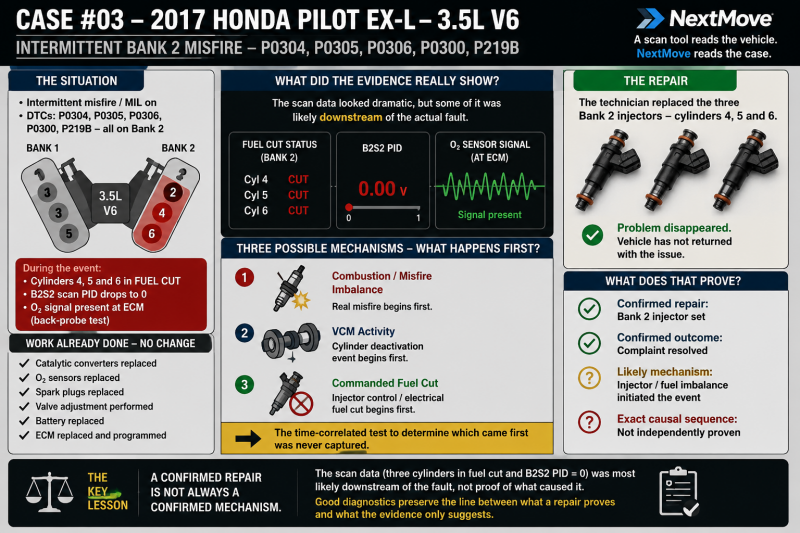
NextMove Case Study #03 — Which Event Happens First?
2017 Honda Pilot EX-L — 3.5L V6, 83,000 miles, DTCs: P0304, P0305, P0306, P0300, P219B
The vehicle had already had extensive work:
Bank 2 catalyst, Bank 1 catalyst, Upstream/downstream O₂ sensors, Spark plugs, Valve adjustment, Motorvac service, Back-pressure testing, Battery, ECM replacement/programming
The fault remained intermittent. Most of the time, fuel trims were normal. Then the event occurred while idling. All three Bank 2 cylinders showed fuel cut. At the same time, the scan tool showed B2S2 = 0 V., but when the technician back-probed the B2S2 signal at the ECM with an oscilloscope, the electrical signal was still present.
So the key contradiction became:
The scan tool says 0 V. The signal at the ECM is still there. And three cylinders on the same bank are being shut down together.
Six directions
A — Injector/cylinder fuel imbalance
Does a real combustion imbalance begin before fuel cut?
B — VCM / cylinder-deactivation control
Does an abnormal cylinder-deactivation event coincide with the fault?
C — Shared Bank 2 electrical / injector control
Does a common supply or control path disappear first?
D — B2S2 signal / PID disagreement
Does the scan PID follow the actual electrical signal?
E — Mechanical / valvetrain
Is there still a genuine combustion fault underneath the event?
F — PCM protective fuel-cut strategy
Are the misfires causing the fuel cut — or is fuel cut causing the misfire codes?
What can already be reduced?
ECM hardware: strongly reduced — replaced, no change.
O₂ sensor hardware: strongly reduced — replaced, with a valid signal seen at the ECM.
Catalyst: reduced as the initiating cause.
Mechanical/valvetrain: parked until the event sequence points back there.
That leaves three main mechanisms:
Real misfire/combustion imbalance happens first
VCM transition happens first
Commanded fuel cut happens first
The next test
Capture one event while monitoring:
VCM/cylinder mode
Misfire counters 4, 5 and 6
Injector/fuel-cut status
B2S2 scan PID
B2S2 raw signal at the ECM
Then ask one question:
Which event moves first?
If misfire counts rise first → investigate injector/cylinder contribution.
If VCM changes first → investigate VCM control.
If fuel cut occurs first while VCM stays normal → investigate the shared control trigger.
If B2S2 PID drops but the raw signal remains → stop chasing the O₂ sensor circuit.
The objective is not to add more possibilities. It is to eliminate them.
What would you watch first in this capture?