Supporting Technicians with Smarter Diagnostic Tools
How NextPhase Auto is helping workshops streamline fault detection—without reinventing the wheel.
Diagnostics Isn’t Broken—It’s Evolving
At NextPhase Auto, we’re not here to challenge the legacy of established workshops. We’re here to support it.
With decades of technician experience behind us, we understand that diagnostic work is part science, part intuition. Our goal is to enhance that process—not replace it—with tools that help techs navigate complex systems more efficiently.

When the Fault Is Real, But the Module Isn't in Charge
Why the next generation of vehicle diagnostics is shifting from "what failed" to "who owns this function"
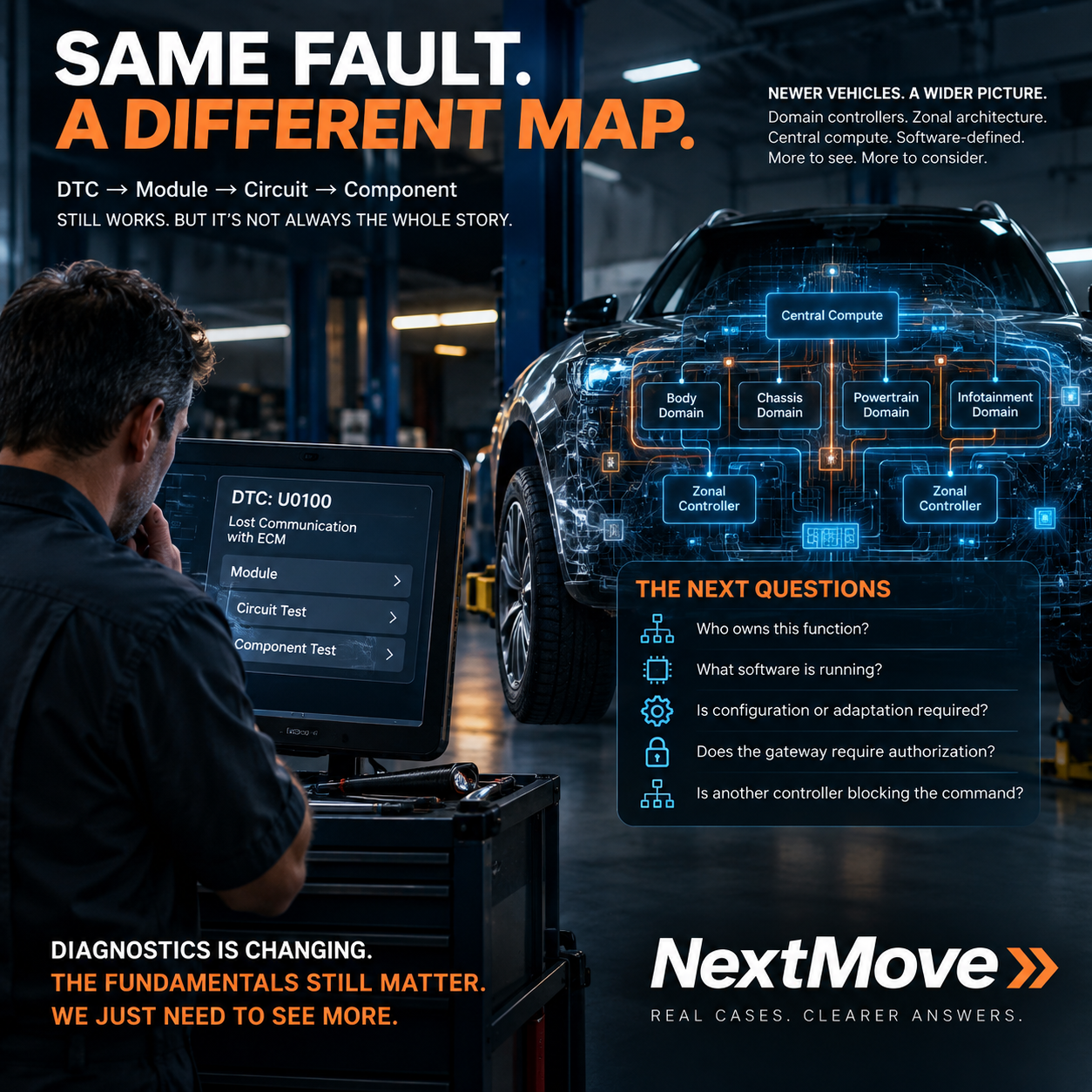
For years, most diagnostic work has followed a familiar path: DTC to module, module to circuit, circuit to component. In a lot of cases, that path still gets you there.
But the vehicles coming through the workshop are starting to change the map. As the industry moves toward domain controllers, zonal architecture and central compute, the old one-to-one relationship between a fault code and a physical cause is breaking down.
One controller may now own several functions at once. A function may depend on the software state of another module entirely. A replacement part may need backend authorization before it's allowed to work. A physical output can be blocked by a controller that has nothing to do with the circuit you're testing. And the DTC itself may only tell you where the problem was detected — not where it actually started.
That changes the job in a subtle but important way. You can have power. You can have ground. The wiring can test perfectly. The component itself can be known good. And the function still won't work.
So the question stops being simply "what failed?" It becomes: "who owns this function, and what has to happen before it's allowed to operate?" That's a genuinely different way of thinking about a fault — and it's not speculation about where the industry might be headed. It's already showing up in how manufacturers are building and documenting these systems.
What the evidence actually shows
Mercedes-Benz engineers have published technical work questioning whether fixed DTC structures are flexible enough for software running on high-performance vehicle computers. A 2024 SAE technical paper co-authored by Mercedes-Benz AG engineers (SAE 2024-01-2981, "Towards Future Vehicle Diagnostics in Software-Defined Vehicles") states plainly that existing DTC-based diagnostic approaches "are not designed for such complex systems and lack of flexibility" — because DTCs are locked in during vehicle development, and adapting them later takes substantial rework.
Volkswagen's own systems already show the same pressure in practice. Gateway installation lists, coding levels and feature-enablement data all have to stay in sync across multiple modules — get that alignment wrong, and the result isn't a working function, it's a fault code.
GM and Ford are already running VIN-specific, server-connected programming, where the calibration a vehicle receives is tied to its identity and pulled from the manufacturer's own systems rather than sitting locally on a disc or a tool.
And the industry has introduced SOVD — ISO 17978 — to sit alongside traditional UDS, purpose-built to support diagnostics on software-defined, high-compute vehicles where the old service-oriented model doesn't fully translate.
What this doesn't mean
The scan tool isn't becoming obsolete. It's becoming one piece of a bigger diagnostic picture. The fundamentals — voltage, ground, current, waveforms, mechanical condition, proof — still matter as much as they ever did. Nothing about function ownership or software state replaces the need to verify a physical effect.
What's changing is what sits alongside those fundamentals. Increasingly, that means understanding function ownership, software state, authorization, network dependencies and system state — not as a replacement for hands-on diagnostic skill, but as an extension of it.
This isn't a move away from technician skill. It's technicians having to see more of the vehicle than ever before.
Are you starting to see this shift in your own workshop yet?

What We’re Building
-
Overlay Logic: Phrasing triggers and fault tiering that match how techs actually speak and think
-
Training Modules: Rhythm-based recall decks and scenario-driven flashcards
-
Diagnostic Mesh: A living archive that blends technician phrasing, forum logic, and predictive overlays
-
Real-World Integration: Tools that work with existing scan tools, not against them
-
Why It Matters
-
Modern vehicles—from ICE to hybrid to EV—are packed with systems that can overwhelm even seasoned techs. Our tools are designed to:
-
Reduce diagnostic guesswork
-
Surface relevant fault patterns faster
-
Help techs train smarter, not harder
-
Respect the workflow already in place
-

Evs are charging ahead—but the game’s getting complex
One of the biggest shifts in the car world right now is the rapid rise of electric vehicles (EVs)—but it’s not just about swapping petrol for lithium. The whole landscape is evolving:
- Battery tech is surging: Solid-state batteries are on the horizon, promising longer life cycles and faster charging
- Peak ICE is approaching: Internal combustion engines are expected to be overtaken by EVs globally by 2036.
- Cybersecurity is now critical: With cars becoming rolling computers, protecting vehicle networks from hacks is a growing priority.
- Autonomous tech is scaling: Robo-taxis and shared autonomous shuttles are inching closer to mainstream deployment.
- Australia’s market is shifting: After record sales in 2024, prices are expected to drop in 2025 as supply stabilizes and cost-of-living pressures bite.

Myth buster: “modern cars are too complex for DIY repairs”
This one’s everywhere—and it’s only half true.
Yes, newer vehicles are packed with modules, encrypted networks, and software-driven systems. But that doesn’t mean DIY is dead. What’s really changed is the type of knowledge needed:
- 🔧 Old-school spanners meet scan tools: You still need mechanical basics, but now you also need to speak “CAN” and understand fault codes.
- Phrasing matters: Forums, scan tools, and overlays rely on precise language. Knowing how to describe a fault can be just as powerful as knowing how to fix it.
- 📲 Access is expanding: With mobile diagnostics, QR-linked guides, and AI-ready overlays (like the ones Nextphase is building), techs and DIYers alike can decode faults without a full workshop setup.
The real myth? That complexity equals exclusivity. In reality, it’s just a new kind of literacy—and with the right tools and phrasing, anyone can learn to read it.
Stay informed with nextphase auto
Keep up with the latest tech insights and diagnostic solutions. Contact us today to learn more about how we can help you stay ahead in the automotive industry.